 admin
adminStarlink has officially disabled all satellite internet services in Uganda after receiving directives from Ugandan authorities, citing regulatory noncompliance and national security concerns ahead of the country’s January 2026 general elections.
What Happened?
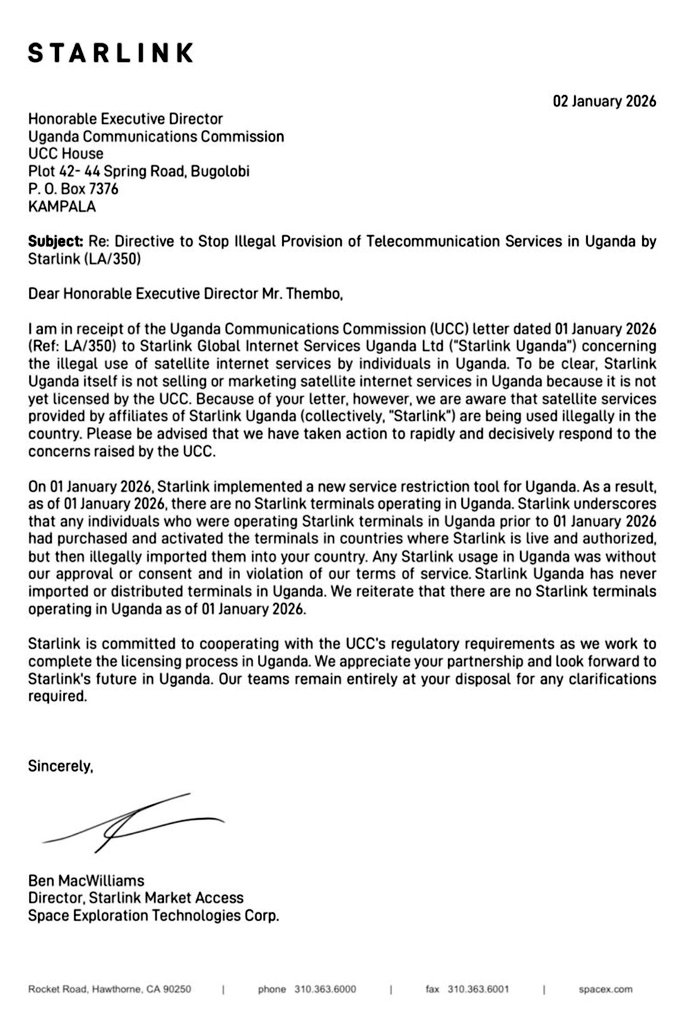
Starlink confirmed that it activated a new service restriction tool to ensure that no Starlink terminals remain operational within Uganda’s borders. As of January 1, 2026, the number of active Starlink terminals in the country dropped to zero, resulting in an immediate blackout for existing users.
The shutdown followed a formal order issued by the Uganda Communications Commission (UCC), which stated that Starlink was providing services illegally in Uganda without the required operating licence.
Why Starlink Was Operating Without a Licence
According to Starlink, the company has never officially sold, marketed, imported, or distributed Starlink kits in Uganda. Instead, the active terminals in the country originated from unauthorized imports, where individuals purchased Starlink equipment in licensed countries and brought the kits into Uganda for private use.
Starlink stated that this usage occurred without its approval and in violation of its terms of service. In response to the UCC directive, the company said it acted immediately to enforce geographic restrictions while continuing discussions to complete the formal licensing process.
Government and Military Involvement
In parallel with the UCC’s order, the Uganda Revenue Authority (URA) issued an internal directive to customs officers restricting the importation of Starlink equipment. The memo required that any Starlink-related hardware entering the country be accompanied by written clearance from the Chief of Defence Forces.
This measure effectively placed Starlink equipment under military oversight. Officials cited concerns that Starlink’s satellite-based system bypasses local telecom infrastructure, making it difficult for authorities to monitor communications or enforce internet controls during sensitive political periods.
Election Timing and Security Concerns
The actions against Starlink occurred just weeks before Uganda’s mid-January 2026 elections. Authorities expressed concerns that unrestricted satellite internet access could be used to bypass information controls, encryption monitoring, or potential internet shutdowns during the election period.
Government officials emphasized the need to enforce existing laws, including licensing requirements, landing rights, and communication interception regulations that apply to all internet service providers operating in Uganda.
Impact on Users and the Digital Economy
The immediate effect of the shutdown was a complete loss of Starlink connectivity for users across Uganda. This disproportionately affected:
- Rural and remote communities with limited broadband options
- Small businesses and startups reliant on stable internet
- E-learning initiatives and remote work
- Disaster-prone regions that previously depended on satellite connectivity
Observers noted that Uganda risks falling behind neighboring countries such as Kenya and Rwanda, where Starlink is already licensed and operational.
Starlink’s Position Going Forward
Starlink stated that it is committed to cooperating with Ugandan regulators and is actively working to complete the licensing process required to operate legally in the country. The company emphasized that the service restriction is temporary and tied strictly to regulatory compliance.
Until licensing is finalized, Starlink services will remain unavailable in Uganda.

 admin
admin